
We know that our days are shaped by natural rhythms – sunrise and sunset, warming and cooling, light and darkness. But rivers have rhythms too. Now, technology is allowing us to see those patterns in detail.
Through funding from the Community Waterways Partnership (CWP), the Ōpāwaho Heathcote River Network has deployed an Aquawatch WaQA continuous water-quality monitoring system on the Waimōkihi, immediately upstream of its confluence with the Ōpāwaho Heathcote River.
Unlike traditional water sampling, which provides a snapshot of conditions at a particular point in time, the WaQA system records water quality automatically every 15 minutes, 24 hours a day. It continuously measures five key parameters, including water temperature, dissolved oxygen and pH. The resulting data is revealing a clear daily rhythm in the river – one closely linked to sunlight, temperature and rainfall.
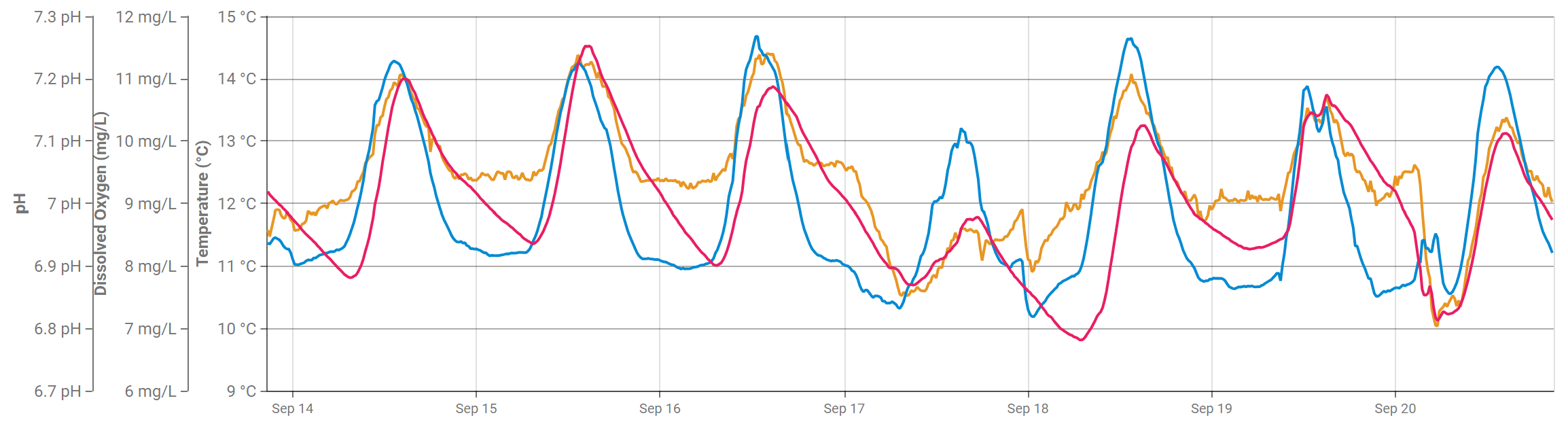
A week in the life of the river To see this rhythm in action, let’s look at the monitoring data from 14–20 September this year, a fairly typical week for this time of year. There was a sustained period of rain on 17 September, followed by a brief shower in the early hours of 20 September. The graphs below show how the river responds not only to changing weather conditions, but also to the daily cycle of daylight and darkness.
Water temperature It might seem reasonable to expect a spring-fed river to maintain a relatively stable temperature. The monitoring data tells a different story. The temperature of the Ōpāwaho is influenced by air temperature, sunlight and rainfall. In Christchurch, September air temperatures typically range from around 4°C to 15°C, with a mean of approximately 9°C.
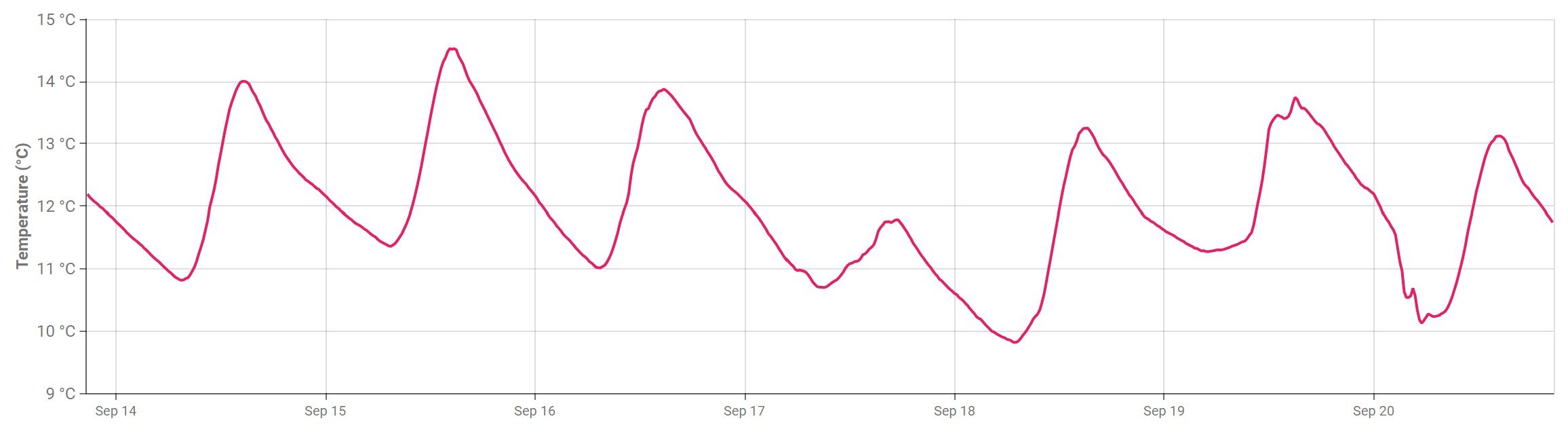
Water temperature over a week as recorded by our WaQA device.
At this time of year, the water temperature recorded by the WaQA system can vary by almost four degrees during a single day. Temperatures are generally lowest in the late morning, at around 11°C, before rising to a peak of approximately 14°C at about 3pm.
Rainfall can quickly change this pattern. When rain arrives, cooler water lowers the day’s peak temperature and can also result in a lower starting temperature the following day.
The guideline value for water temperature in a spring-fed, plains, urban waterway in Canterbury is 20°C or below. Keeping temperatures below this value is important for maintaining a healthy aquatic ecosystem.
Dissolved oxygen Dissolved oxygen is essential for aquatic life. Oxygen enters the river directly from the atmosphere, with turbulence and wave action helping to mix it into the water. Aquatic plants, algae and phytoplankton also produce oxygen through photosynthesis when exposed to sunlight.
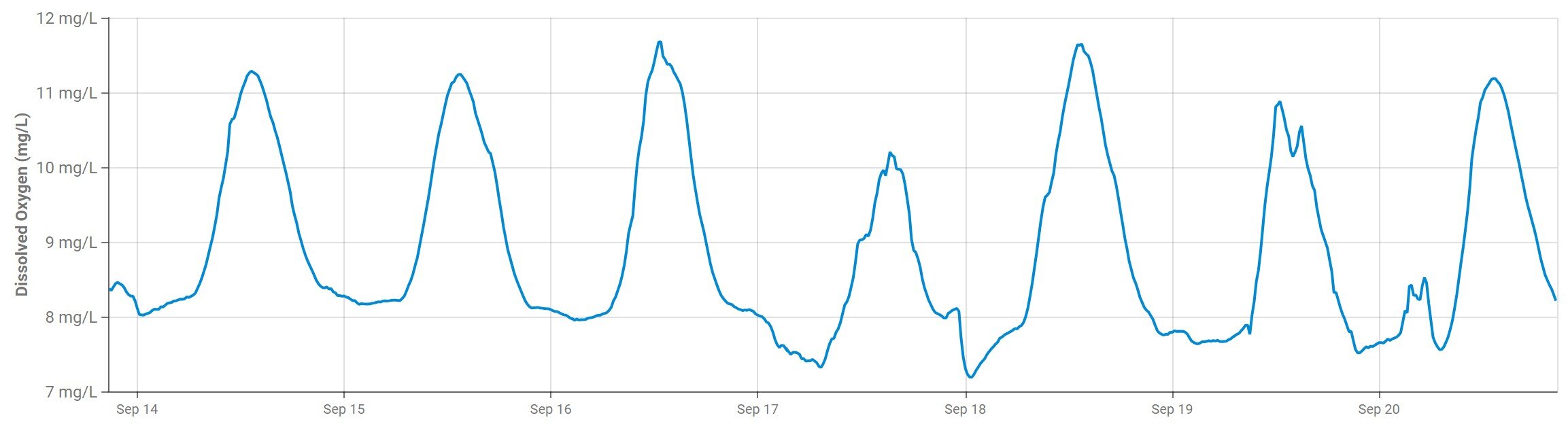
Dissolved oxygen over a week as recorded by our WaQA device.
The monitoring data clearly captures this daily cycle. Dissolved oxygen levels rise during daylight hours as photosynthesis takes place and generally fall overnight as plants, algae and microorganisms consume oxygen through respiration.
The effect of weather is also visible. On 17 September, when rain and cloud reduced the amount of sunlight reaching the river, dissolved oxygen levels were slightly lower.
Temperature also matters. Warmer water holds less dissolved oxygen, while higher temperatures can increase the rate at which aquatic organisms consume oxygen. This is one reason maintaining shade along waterways is important: vegetation can help moderate water temperatures and support healthier conditions for aquatic life.
pH – acid or alkali The pH scale tells us whether water is acidic or alkaline. A pH of 7 is neutral, while values below 7 are acidic and values above 7 are alkaline. Although pH and dissolved oxygen are not directly connected chemically, they often rise and fall together because both are influenced by biological activity and carbon dioxide levels.
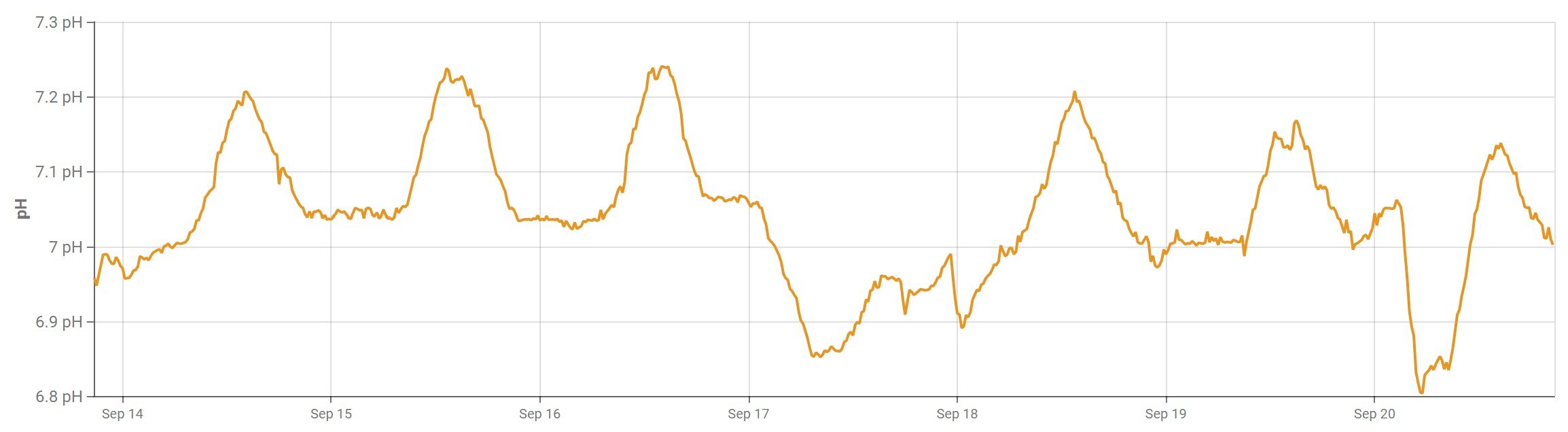
pH levels over a week as recorded by our WaQA device.
During daylight, aquatic plants and algae use sunlight to convert carbon dioxide and water into food through photosynthesis. In doing so, they produce oxygen and reduce carbon dioxide in the water, causing pH to rise.
At night, photosynthesis stops. Plants, algae and microorganisms continue to respire, consuming oxygen and releasing carbon dioxide. When carbon dioxide dissolves in water it forms carbonic acid, causing pH to fall.
Rainfall provides another influence. Clean rainwater is naturally slightly acidic, with a pH of around 5.0–5.5. This helps explain the sharp drops in pH recorded during rainfall on 17 and 20 September. However, as stormwater travels across an urban environment, it comes into contact with materials such as concrete, cement and asphalt, which can increase its pH before it reaches the river. The recommended guideline range for pH in Canterbury spring-fed plains urban surface waters is 6.5–8.5.
The daily pulse of the river Viewed together, the three graphs reveal that the river has a pulse. Driven by the rising and setting of the sun, water temperature, dissolved oxygen and pH all follow recognisable daily patterns. Rainfall can then interrupt or reshape those patterns, providing a glimpse of how quickly the river responds to changing conditions.
Just as people are influenced by the Earth’s daily rhythms, so too are the plants, animals and microorganisms that live in our rivers. The more closely we can observe those rhythms, the better we can understand what the river needs to remain healthy.