
The Ōpāwaho Heathcote River Network has published two free posters. One shows common garden plants that often escape into the river corridor to become pests. The other poster shows pest plants that have taken up residence in or beside the river. Armed with these posters, you can play a role in combating the ecological effects of weeds.
European settlers brought to these shores the plants of their homeland that they missed seeing or using, or plants that they thought might “improve” the pastoral industry of the fledgling nation or beautify its gardens. Actually, they just introduced problems for indigenous ecosystems that climate change will exacerbate, and turned New Zealand into possibly the world’s weediest country.
What makes a plant into a weed? The attributes that make a plant become a weed, given an opportunity to grow unchecked, also guarantee that it will be difficult to remove from the environment once it gets established.
-

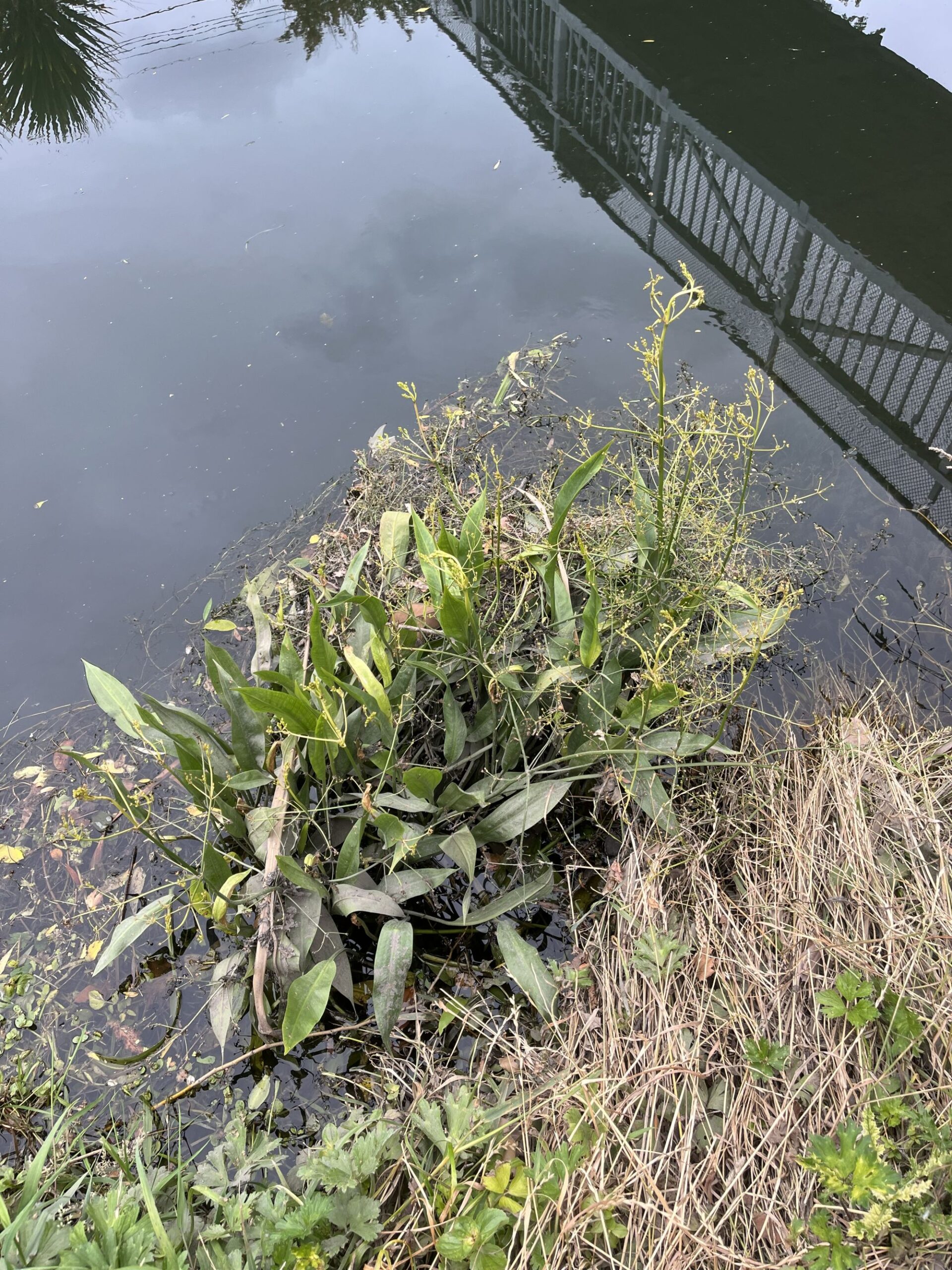
Water Plantain (Alisma plantago-aquatica) happily growing beside the Ford Rd/Fifield Tce footbridge. (Now removed)
Abundant seed production: Pest plants often produce tens of thousands of seeds per plant, allowing rapid population establishment.
- Rapid growth and reproduction: Pest plants often have fast growth rates and can mature quickly, sometimes having multiple generations in a single season.
- Vegetative reproduction: Many pest plants spread efficiently without seeds, using underground structures like tubers, bulbs, and rhizomes. Of dioecious plants (plants that have separate male and female individuals) imported into New Zealand, often only one gender of the species is present, and its seed is unviable; until, that is, the missing male or female is also imported and released.
- High adaptability: Pest plants have an ability to adapt to a variety of environmental conditions.
- Competitive edge: Pest plants are highly effective at competing for nutrients, water, and light, often possessing attributes that inhibit nearby plant growth.
- Dispersal mechanisms: Pest plants have developed effective ways to spread their seeds over long distances.
- Disturbance adaptation: Pest plant seeds have often adapted to germinate in response to soil disturbance.
The issue of biodiversity Pest plants pose a critical threat to New Zealand’s biodiversity by overwhelming native ecosystems, often displacing indigenous plants and altering habitats. They can smother native vegetation, disrupt wildlife food sources, alter soil chemistry, and ultimately lead to a reduction in native species and ecosystem diversity.
The riverbank before weeds: The original native vegetation of the Ōpāwaho Heathcote River margins comprised relatively tall, long-lived species of sedges, rushes and grasses, harakeke, toetoe, tī kouka (cabbage tree) and raupō. When this native riparian cover was removed as the city developed, the banks of the river and its margins were colonised by mostly exotic plants – almost all of them pest plants.
What can you do about it? In the face of landscape-scale issues like pest plant management, it can often seem as if the problem is too large and the weeds too widespread for you to make any impact. In a sense, this is true. One person cannot alone alter the history of pest plant spread. But one person can make their own property pest plant-free and, in doing so, can reduce the local spread of pest plant species, particularly into the river corridor, where plentiful water offers a rich ground for colonisation. If two or three neighbours jointly tackle pest plants on and near their properties, the possible impact of the pest plant is decreased further. Preventing pest plant spread by reducing the seed source is an achievement worth undertaking. The greater the number who take it up, the greater the impact, of course!
Recognition of a weed? The first step is recognising that the pretty plant that grows along your front boundary is actually a pest plant, the seed of which is likely to spread into the river corridor or be carried by the winds or birds into the rocky outcrops of the Port Hills. As a nation, we have become so overwhelmed by the proliferation of exotic plants and trees that knowing which plants are exotic and pest-like is difficult; many residents cannot tell which plants are exotic and which are native. We wrote about this worrying extinction of experience previously.
Stop weeds taking over Poster – click to download a copy
Stop weeds taking over When ŌHRN set out to make a poster of common weeds that residents of the river corridor might remove from their properties to help the wild spaces of our city, the difficulty was in keeping the list down to a manageable number. The poster that we have created lists a selection of plants that would be better out of your property than growing there and contributing to the seed base in the river corridor. The poster indicates the best ways to deal with them.
Weeds of the Ōpāwaho Poster – click to download a copy
Weeds of the Ōpāwaho Heathcote River ŌHRN has also created a poster to help with the identification of the worst weeds associated with the river. Again, the list could have been much longer. It’s harder to know what to do about pest plants that are in or beside the river. Some especially horrible weeds are able to be reported to Environment Canterbury or the City Council for removal. The ŌHRN is involved in eradicating or controlling several of them. Some are so prolific that, at this time and with available technology, it is not possible and/or cost-effective for the City Council to control them.
How can you get copies of the weed posters? You can obtain pdf copies of the posters by clicking on their images but if you would like hard copies of the posters, you can receive them by completing this simple online form. We will post them to you for free.