
This November, the Ōpāwaho Heathcote River Network is commencing a programme to eradicate a pest plant before it takes over much of the riverbank and chokes the Ōpāwaho Heathcote River. At the same time, the Network is endeavouring to stop another pest plant from spreading further up the river.
Reed Sweetgrass (Glyceria maxima) is named in a 2024 list of 386 environmental weeds in New Zealand prepared by the Department of Conservation. Glyceria forms a dense monoculture in nutrient-rich water, matures quickly, has a rapid growth rate, and overtops competitor plants. Glyceria’s rhizomes spread outwards, breaking off and rooting in any damp spot; weed-clearing efforts along the river really help to spread this weed.
The effects of Glyceria It is not hard to imagine a time in the future when, thanks to birds, people and machines spreading plant fragments, this grass gets up to the retention ponds that have been recently opened in the Cashmere Valley, Wigram and at Te Kuru wetland or into the Travis Swamp. It would likely out-compete and kill most of the native grasses and plants in those basins. It would create an ongoing and expensive need for constant removal so that the ponds were able to fulfil their flood-prevention role. Similarly, if this plant is allowed to spread along the river, the cost of continually harvesting it to allow the river to adequately drain the city would be substantially greater than it is already.
Eradicating Glyceria Since we do not want that scenario to play out, the Ōpāwaho Heathcote River Network is embarking on a project to eradicate Glyceria from the river, utilising Better Off Funding that we obtained from the Waihoro Spreydon-Cashmere-Heathcote Community Board. Currently, we have pinpointed about 50 locations of Glyceria within a 5.25km stretch of the river. We have contracted experienced and qualified people at CityCare Property, who have undertaken this work previously, to spray out all the Glyceria locations using a glyphosate product. There will be limited effects on the river ecology from this.
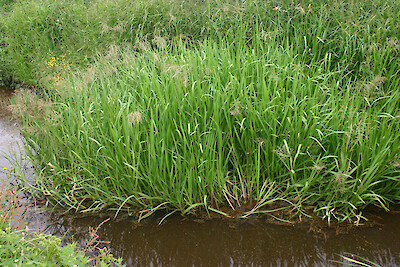
A clump of Glyceria maxima
Timing is critical There is a limited window of opportunity during which this eradication exercise can take place. Eradication efforts must avoid inaka spawning from late January to June, and the inaka gathering season of September and October. It cannot take place in the winter due to Glyeria foliage being affected by frost. Therefore, November, December and early January are the only available months when eradication efforts can take place and even then, contractors can only work in fine weather over the period of low tide to maximise effectiveness. In order to achieve eradication, treated ares will be monitored for regrowth with further treatment planned in future years as necessary.
What does Glyceria look like? If you walk along the riverbank in the summer months, look for a stand of bright green, vertical swords in a clump with perhaps some leaning over where the wind or water has bent them down. Glyceria contrasts its bright green growth with the blue-green of canary grass and raupō. Its growth tips are rounded like the shape of a boat prow. Reed Sweetgrass (Gylceria maxima) has been identified in the Ōpāwaho Heathcote River since about 2017. It is widely naturalised and abundant in most lowland parts of the North Island and in scattered wetlands in the South Island. It was foolishly brought into New Zealand in 1906 as a stock feed but while it is apparently an excellent feed, it only grows in wetlands where it happily tolerates being eaten by stock while they wallow in the wet mud it prefers.
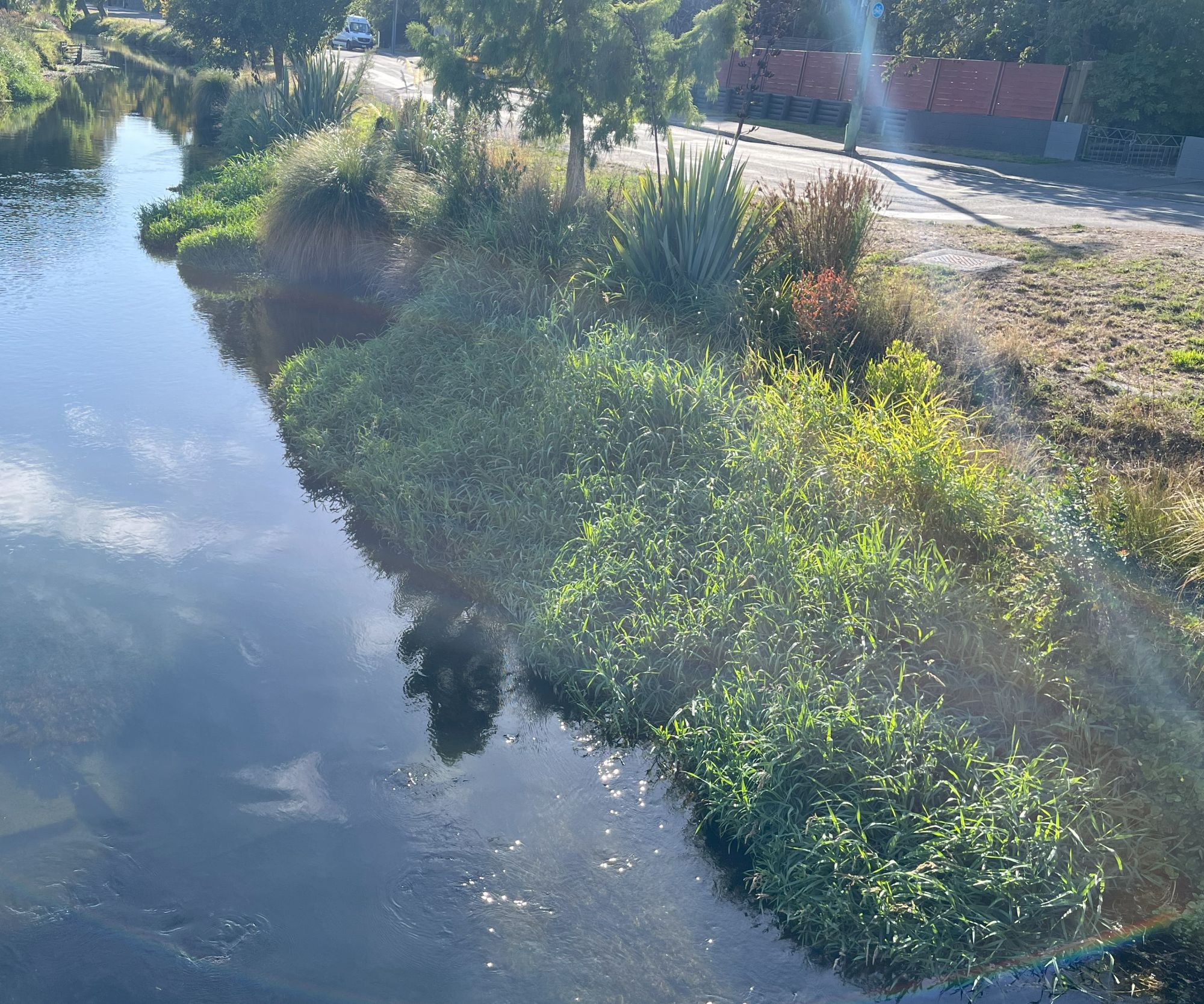
A patch of Reed Canary Grass beside the Beckford Road bridge.
Canary grass While Glyceria spreads along the riverbank, it competes with another pesky grass that is also taking over the margins of the river – Reed Canary Grass (phalaris arundinacea). As a trial, the Network is attempting to remove Canary Grass from the riverbanks, starting at its current most upstream location beside the Ford Road/Fifield Terrace footbridge down to the Beckford Road bridge. If it proves possible to spray out these clumps of Canary Grass along this stretch of the river, and to keep the grass from coming back, then in future seasons we will endeavour to remove Canary Grass from the next downstream section of the river. This will be a challenge as it will include the planted margins of Hansen Park.
Why is Canary Grass here? Introduced to New Zealand in 1874 as a pasture plant, Canary Grass was quickly rejected as relatively useless for the task because of its water preference. It did not take long to escape from farms and find a niche for itself. It now thrives under the shade of willows and open kahikatea forest, in wet grasslands, wet waste areas and roadsides and along the margins of water bodies like the Ōpāwaho Heathcote River. You can easily identify it: look for the tall grasses with a slight purple shading to the green of the pointed leaf.
Canary Grass spreads While canary grass is widespread throughout New Zealand, it has taken until quite recently for it to arrive in the Ōpāwaho Heathcote River. It probably arrived in the river in the early 2000s and quietly established itself in the lower reaches. Its spread has been inadvertently assisted by the Christchurch City Council’s regular weed-clearing operation along the river. As the weed-harvesting machine has chomped the clumps of canary grass that have intruded into the waterway or the workers with handheld weedeaters have merrily shredded the canary grass while clearing the riverbank, stem and rhizome fragments of the grass have floated up and down the river on the tides, gradually colonising the riverbank.
What canary grass does Once established, canary grass is capable of rapid colony spread. It typically spreads by shoots arising from shallow rhizomes which can extend over 3m per year underground and form a thick impenetrable mat below the soil surface. These rhizomes have numerous dormant buds that are the primary means for resurgence of the plant when above-ground growth is removed. Rapid expansion, early growth, and the mulching effect of a dense litter layer all work to facilitate the decline of competing native species. Only the native raupō appears to be able to out-compete canary grass in the river margins.
Why so weedy? New Zealand is quite likely the most weedy country in the world but we didn’t get there by accident. The colonising farmers of the late 1800s and early 1900s went out of their way to bring in new species of plants to make up for what was seen as deficient native grasses; deficient from the point of view of nutrition for cows and sheep. Gardeners have added to this with exotic plants that have escaped gardens and spread into the wilder places.
That is why it is so important for residents to join the war on weeds and remove the most common ones from their properties. This slows the spread of weedy plants into the wilderness areas and helps the native flora compete for nutrients and sunlight.