
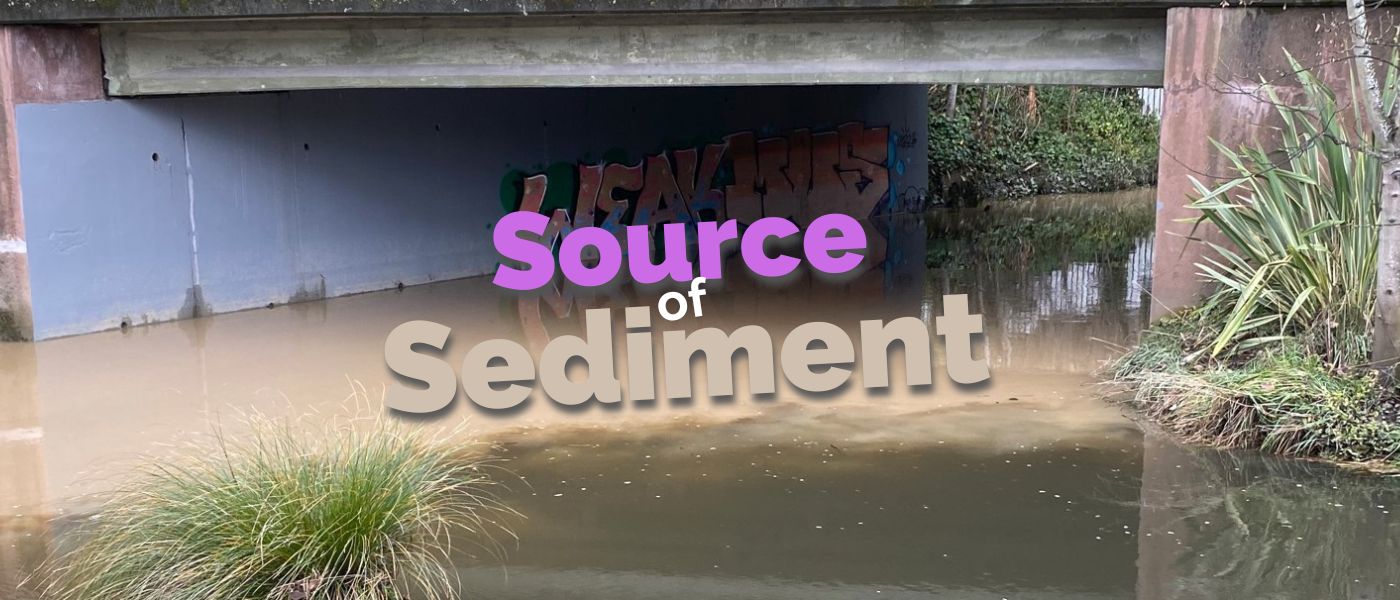
[This article first appeared in August, 2025] After heavy rain, the Ōpāwaho Heathcote River runs an uninviting shade of brown. If you trace the flow upstream, the trail leads to very clear culprits.
At the Confluence, where the Cashmere Stream meets the Ōpāwaho Heathcote River beneath Cashmere Road, you can see the difference with your own eyes. From a Euro-centric map view, the Cashmere Stream is joining the Ōpāwaho Heathcote River; from a mana whenua perspective, the Waimōkihi is joining the Ōpāwaho. Either way, the Waimōkihi’s water runs mostly clear, sourced from artesian springs at Nga Puna Wai and carrying only a light load of sediment from road and residential stormwater.
By contrast, the Cashmere Stream flows in thick, clay-coloured swirls, like used water drained from a potter’s wheel. Where the two meet, the clear and cloudy currents twist together in striking patterns before merging completely.
Just 150 metres further up the Cashmere Stream, there is a repeat performance. Here, in Worsleys Reserve, the Cashmere Stream is joined by the Cashmere Valley Drain. The stream’s flow from the Te Kuru wetlands runs clear, but the water from the drain is again thick with sediment.
The Cashmere Valley Drain, dug by Indian labourers in the 1840s for Sir John Cracroft Wilson’s estate, now carries the outflow from retention ponds, wetlands, and the Cashmere Dam – structures built to slow water and trap at least a little sediment. The ponds and dam receive a constant supply of sediment from four main sources.
Cashmere Estates New housing here sits on loess soils. Loess is a fine, windblown sediment that is highly erodible. In stormwater, loess stays suspended for a long time. The developers have utilised settling ponds, but these have done little during rain to reduce the sediment-laden runoff entering the wetlands and retention ponds.
Christchurch Adventure Park (CAP) Also built on loess soils, CAP’s mountain-bike tracks carve across slopes, exposing loess soil and channelling water downhill – perfect conditions for erosion. Although CAP management has tried to reduce sediment by rock-armouring stream banks and enlarging settling ponds, they have never met their consent conditions for water quality. Two major Port Hills fires have further stripped vegetation, worsening erosion.
McVicar forestry block Pine plantations surrounding and above CAP create erosion risks during the 25-year growth cycle of the trees, and especially during harvesting. Despite regulations, harvesting disturbs large areas of loess soil. The Port Hills fires also damaged this block, leaving slopes more vulnerable to erosion.
Road stormwater Dyers Pass and Summit Roads add their share of sediment. Even when the sloped sides of road cuttings are vegetated, they erode into stormwater drains, and kerbing channels this directly into the same stream that passes through the forestry block and CAP before entering the Cashmere Dam.
Where costs may fall Three of these four sediment sources are privately operated. While each operator may claim to minimise erosion, the combined result is still a heavy sediment load in the river after rain. Without enforcement from Environment Canterbury, significant improvements seem unlikely—and even with enforcement, costs may fall on ratepayers, since RMA consents have allowed these activities.
Port Hills Plan Reducing the sediment outflow from the Cashmere Valley will require cooperation between mana whenua, private operators, Christchurch City Council, Environment Canterbury, and Waka Kotahi. The council is now shaping a long-term plan – tentatively called the Port Hills Vision (formerly the Port Hills Plan about which we have written previously) – and we are endeavourng to ensure that community voices are heard as part of the writing process.
For the health of the Ōpāwaho Heathcote River, the businesses benefiting from Port Hills operations will need to step up and be part of the solution.