
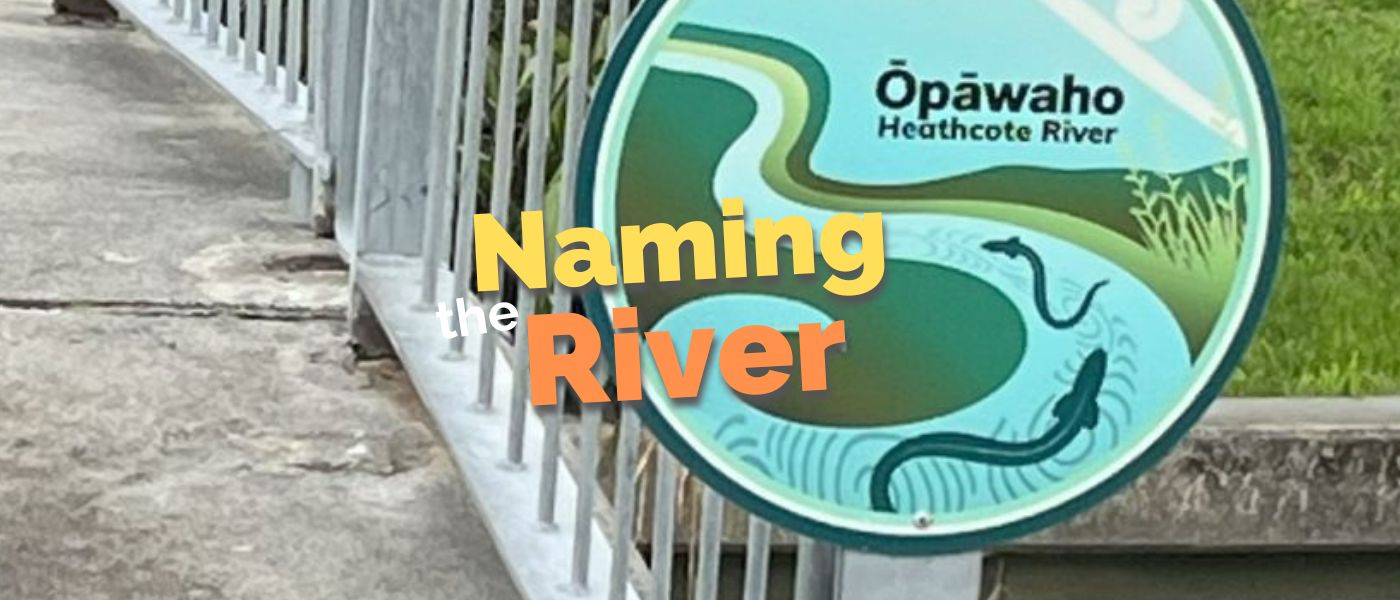
The river has always been known by a name that has been passed down through generations. To help us reconnect and appreciate the river’s true identity, and to allow residents to identify the river as it meanders in its serpentine path beneath the Port Hills, new signs are now guiding our awareness.
If you have recently crossed any of the footbridges spanning the Ōpāwaho Heathcote River, you may have noticed round, colourful, stylised signs displaying its name. The goal is simple yet powerful: every time we cross the river, we recognise it by name. Footbridges have been signposted, and road bridges will soon follow.
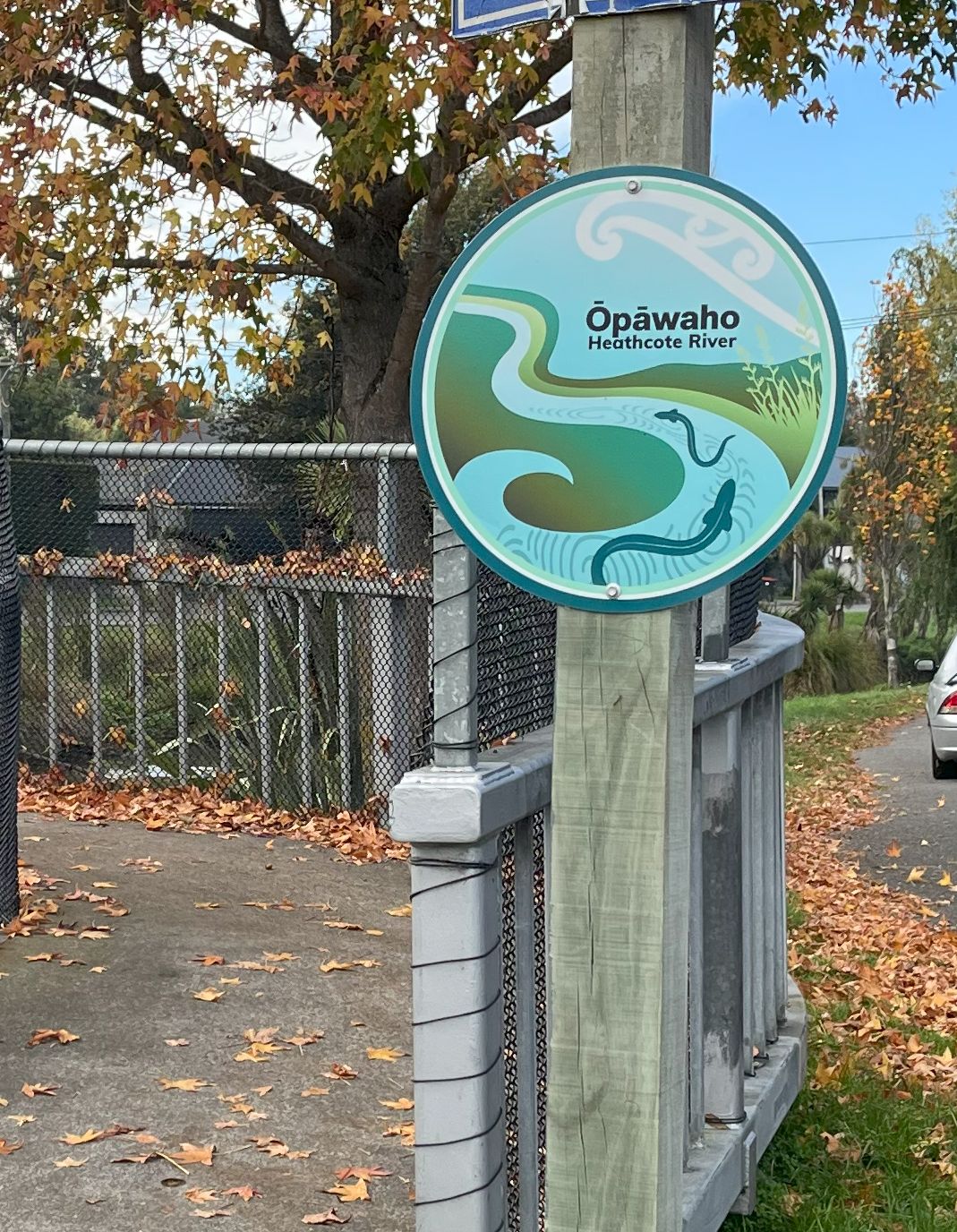
New sign of the Ford Road/Fifield Terrace footbridge.
These new signs result from a collaborative effort between the Christchurch City Council’s Parks Visitor Experience signage team and Ōpāwaho Heathcote River Network (ŌHRN), a project that began in 2021. Graphically designed with care and artistry by Ariki Creative, these signs celebrate the river’s cultural and natural significance. All design credits go to Ariki Creative; ŌHRN’s role was to select from alternative designs and offer refinement suggestions.
By elevating the river’s profile in this way, we aim to acknowledge its rightful status as a taonga — a treasured gift — of our city. Unfortunately, this regard has not always been evident. Historically, many residents saw the Ōpāwaho as a mere backwater drain, and their treatment of the river reflected this diminished value. It was only in more environmentally conscious times, particularly following the local government reforms of the 1980s, that the importance of river health gained traction.
We must also acknowledge the role of mana whenua has played in elevating the importance of water. Ngāi Tahu has long regarded the rivers of the plains as taonga — treasures to be cared for, passed down from ancestors to sustain life. It has taken over 150 years for the wider community in Christchurch to shift from exploiting this particular river to respecting and protecting it.
The original Māori name for the river is Ōpāwaho, meaning “the place of the outpost pā,” named for the site where Māori travelling from Kaiapoi to Te Wahora would pause to gather food and rest. This temporary pā was located where the railway and Brougham Street cross the river, just downstream of the Opawa Road bridge.
When the Canterbury Association established Christchurch as a cathedral city, they followed common practice at the time: naming key features after prominent patrons. Ignoring the indigenous name, the settlers renamed it the Heathcote River, after Sir William Heathcote, 5th Baronet, a British landowner and politician who never set foot in New Zealand but whose support helped fund the settlement. Consequently, from 1850 onward, the European name dominated maps, signs, and everyday speech, while the Māori name faded from common use.
From that period, the river’s health also declined. In addition to residential sewage flowing into the river, industries that rapidly established along its banks – fellmongeries, tanneries, rubber works, and wool scouring – polluted the waters. It was not until the construction of the Woolston industrial sewer in 1966 that wastewater pollution was somewhat alleviated. Even today, wastewater overflows, stormwater discharges, and sediment washed from the Port Hills continue to pollute the river after heavy rain, and much work remains to restore its natural vitality.
Fortunately, attitudes are shifting. The health of the Ōpāwaho appears to be very gradually improving, aided by increased environmental awareness and community efforts. The new signs, bearing both its Māori name and that given by European settlers, serve as a reminder of the river’s significance for the city and of our ongoing journey toward respectful stewardship of it.
We hope these signs inspire us all to see the Ōpāwaho not just as a waterway, but as an enduring taonga that reflects our city’s history, culture, and hope for a sustainable future.