
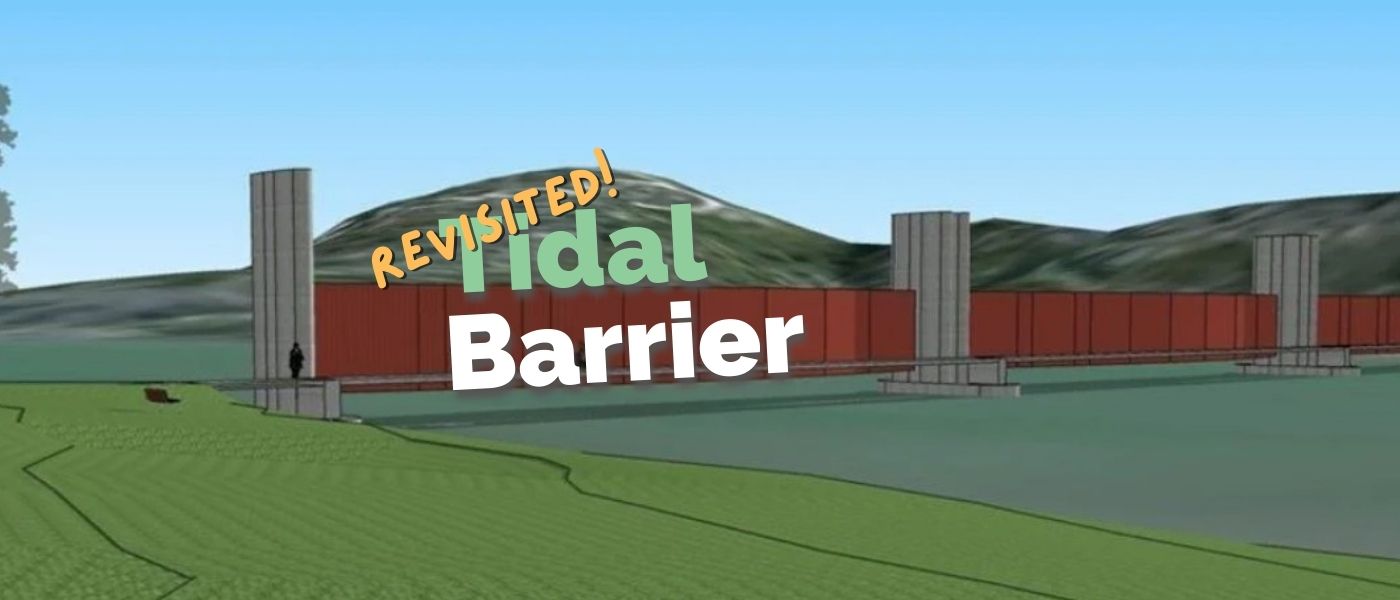
Christchurch’s re-elected Mayor, Phil Mauger, has revived discussion about building a tidal barrier as a potential response to flooding in the city.
The Mayor’s comments follow recent king tides, which caused minor flooding along streets near the Ōpāwaho Heathcote River. Perhaps these tides – and possibly the appeal of a long-term legacy project – have prompted the Mayor to ask Council staff to revisit an idea that was first looked at seriously in the 1960s and later examined again in 2015.
What is a tidal barrier? A tidal barrier is a structure normally left open to allow the daily movement of tides. It can be temporarily closed for several hours to block the peak of a high tide or storm surge from entering an estuary. This prevents water from backing up into rivers that flow into the estuary and reduces the risk of flooding upstream. While the barrier is closed, river water continues to enter the estuary. Once the tide drops, the barrier reopens and the estuary drains as usual. In theory, this cycle could be repeated across several high tides if required.
Proposals for Ihutai Avon Heathcote Estuary have focused on especially high tides – king tides and storm surges – and assume the barrier would only need to close a few times a year under current conditions.
What did the 2015 report actually examine? The 2015 study was part of the Land Drainage Recovery Programme, which included 100+ different investigations into Christchurch’s post-earthquake flood risks. The tidal barrier assessment was a pre-feasibility study – essentially a quick, low-cost check to determine whether the engineering concept was viable. Crucially, it did not examine the environmental, ecological, financial, or social implications of building a tidal barrier.
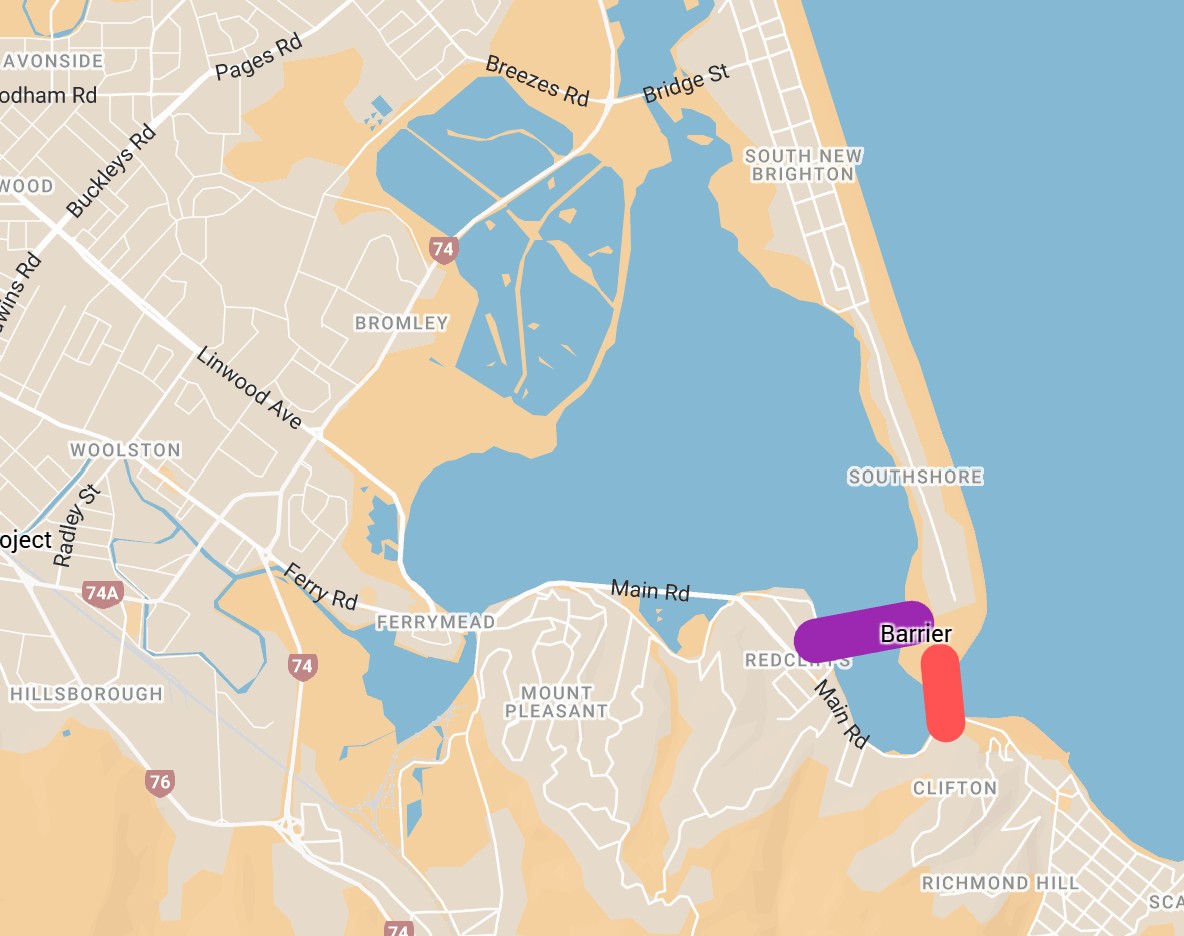
Possible siting for a tidal barrier.
Where could a barrier be built? Two main locations have been proposed:
- Across the estuary mouth, from near Shag Rock to the end of the Southshore Spit. (Red in the map)
- Between Beachville Road in Redcliffs and the Southshore Spit, at a more stable point of the spit. (Purple in the map)
The spit is quite unstable and over recent decades has changed its shape and position in response to effects from the Waimakariri River and beyond. Attempting to attach a major structure to the spit would be a major engineering challenge in itself.
A Beachville Road location would protect only parts of Redcliffs from tidal peaks. To function effectively, any tidal barrier would also require the construction of new seawalls along the lower Ōtākaro Avon River.
How would a barrier affect the estuary? Although environmental impacts were outside the scope of the 2015 report, previous modelling has indicated that a barrier would increase sedimentation in the estuary. Since the estuary’s ecology is heavily shaped by sediment patterns, this would inevitably lead to ecological changes – almost certainly negative. Likely effects include reduced shellfish and other mud-dwelling organisms and fewer birds feeding on exposed mudflats.
The barrier would also change the salinity in both the estuary and the rivers. As was found when the Woolston Cut was first put in, small changes in salinity can have significant and unpredictable changes to the ecology and to infrastructure such as river banks.
On the other hand, from a strictly human-benefit point of view, more frequent water coverage might improve opportunities for some water sports.
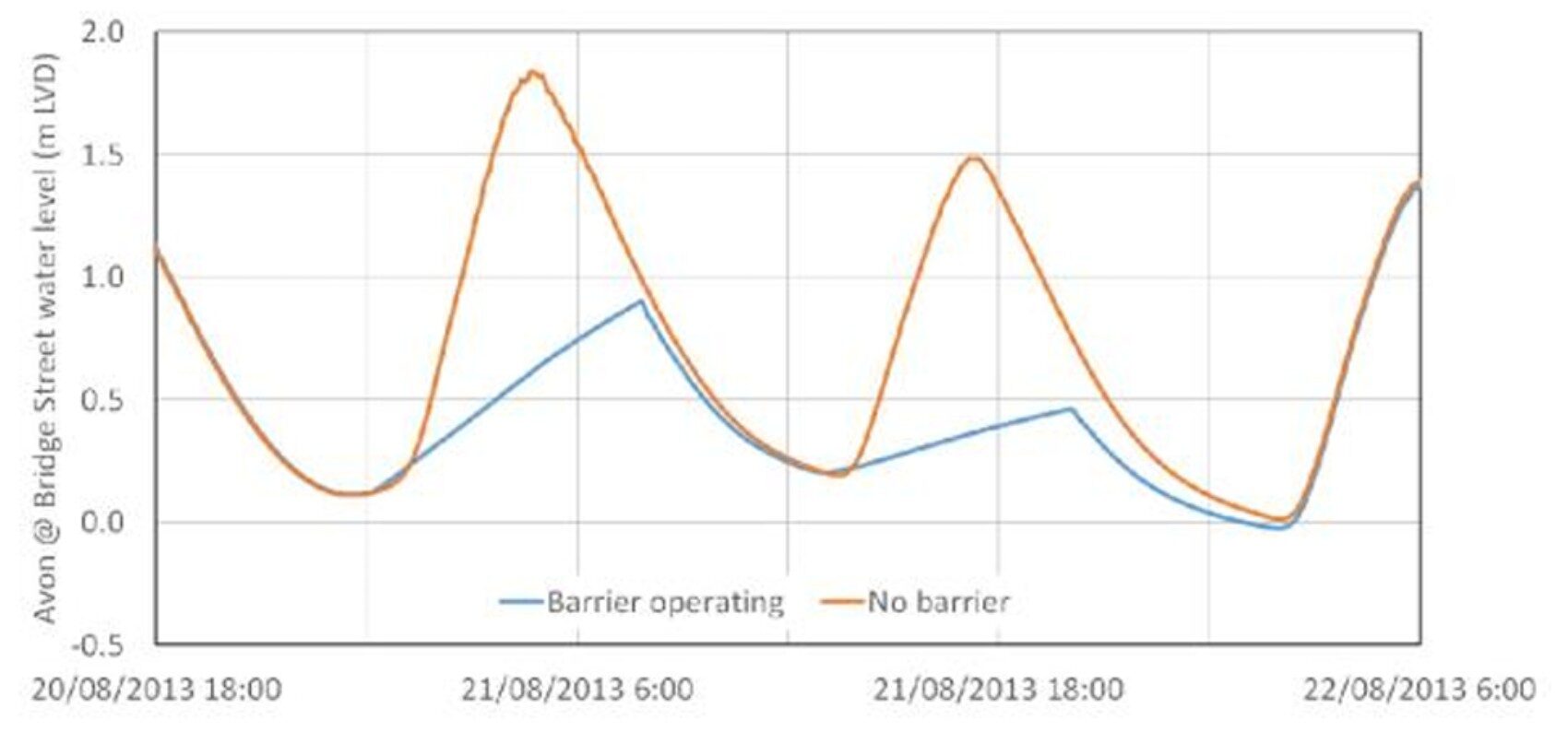
Effect of a tidal barrier placed on the Ōtākaro Avon River at Bridge Street. Desktop exercise.
How does sea-level rise factor in? The 2015 study considered both current sea levels and scenarios with 1 metre of sea-level rise. It found a barrier could be engineered for either case. However, with a 1m rise, the barrier would need to close for most high tides, which would dramatically alter both the shape and ecology of the estuary and rivers. Of course, without a barrier, a 1m rise would fundamentally change the estuary regardless.
What if sea-level rise exceeds 1 metre? Current climate projections suggest at least 30 cm by 2050 and around 1.0 – 1.2m by 2100, depending on global emissions. However, coastal Christchurch is currently subsiding due to earthquake-related land movement, meaning local sea-level rise will be faster than the national average. Areas like Southshore could experience nearly double the projected rise – possibly up to 2 metres by 2100. A barrier designed for 1 metre of rise would not be adequate under this scenario.
Importantly, even a tidal barrier cannot stop groundwater from rising as sea levels rise. Low-lying coastal neighbourhoods may eventually face uninhabitable conditions from groundwater inundation alone – something a barrier cannot prevent.
The larger issue the Mayor has highlighted Generously interpreted, the Mayor’s comments draw attention to a much bigger and urgent challenge: climate change adaptation. On 4 March 2025, the Council adopted its first district-wide Coastal Hazards Adaptation Plan, covering Whakaraupō Lyttelton Harbour and Koukourarata Port Levy. Staff are now developing a framework to determine where adaptation planning should occur next, with recommendations expected in early 2026.
Ideally, Ihutai Avon Heathcote Estuary will be near the top of the list. Any long-term adaptation plan will likely consider a range of engineering interventions – including, potentially, a tidal barrier. Bear in mind that the Council’s adaptation planning concentrates on protecting Council infrastructure rather than private properties.
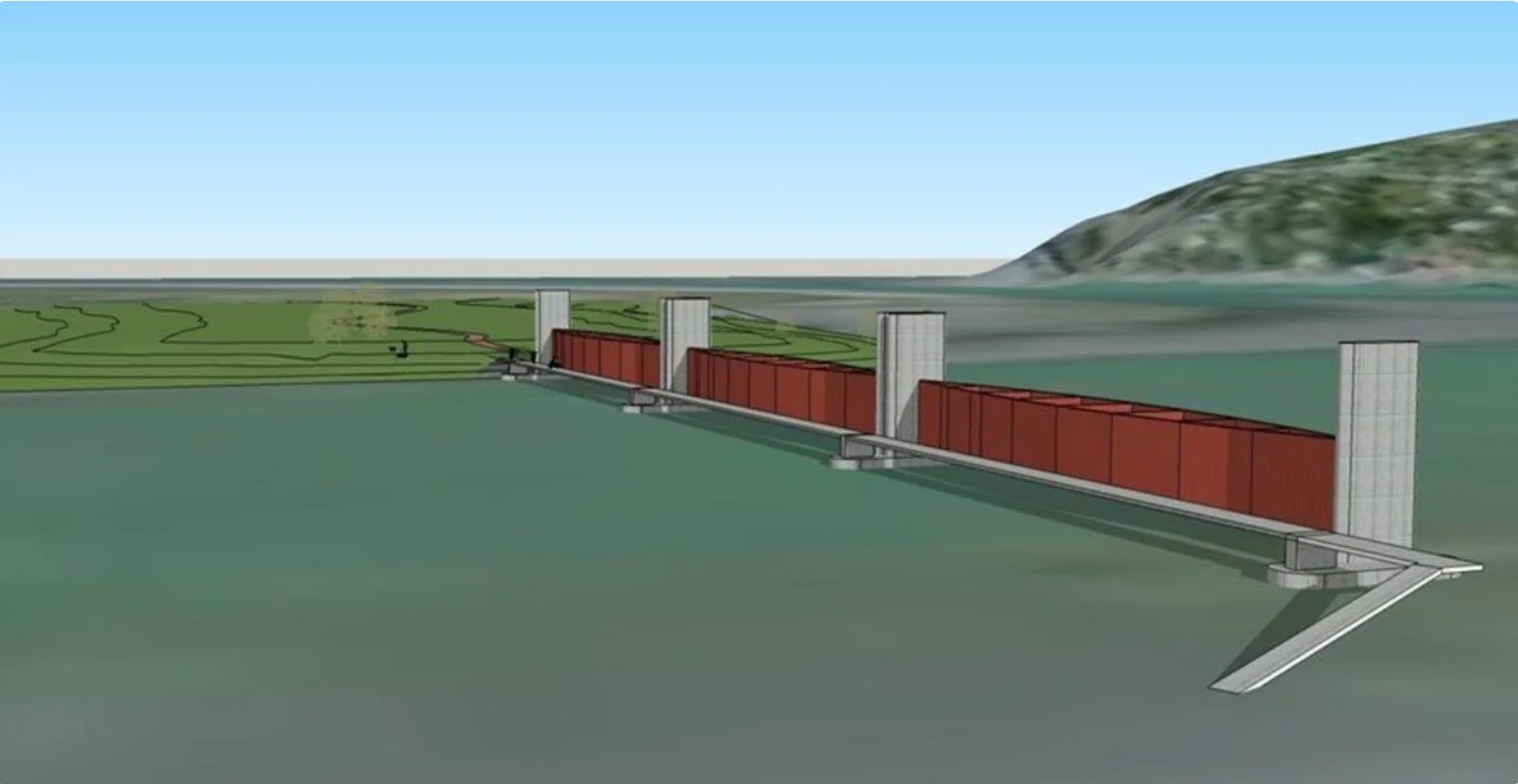
“It is the wrong idea. It is willing nature to do something that it will completely ignore. There are too many environmental risks to the estuary…and it creates a false sense of security.” Lianne Dalziel, 2015. Image: CCC
Natural responses and the case for retreat People place great value on the places they build and inhabit, so retreating from coastal areas is emotionally and financially difficult. Yet natural systems do not recognise human attachments and emotions. In many cases, retreat is the most rational – and cost-effective – response to inevitable changes in coastline and sea level. Any decision is made harder with indications that this Government will not be contributing financially to managed retreat, while local and regional government have limited resources. This seems to leave the homeowner and insurance companies to carry the cost.
As the city debates climate change adaptation, retreat should be considered early in the conversation rather than viewed only as a last resort after expensive technological solutions fail. Engineering can help, but it always comes with higher long-term risks and costs. The Ōpāwaho Heathcote River Network is in complete agreement, as quoted above, with Lianne Dalziel, Mayor when the City Council decided not to advance the 2015 report on a tidal barrier proposal. A tidal barrier is an expensive engineering solution to a problem best resolved by managed retreat and allowing for natural change in the ecology of the estuary. It is deeply ironic that just upstream of the estuary sits the Woolston Barrage, an engineering solution to an ecological and environmental disaster caused by an engineering solution to flooding – the Woolston Cut!