

During the last week of June 2025 the lower Ōpāwaho Heathcote River was higher than normal – it was a time of king tides – or more correctly Perigean Spring Tides.
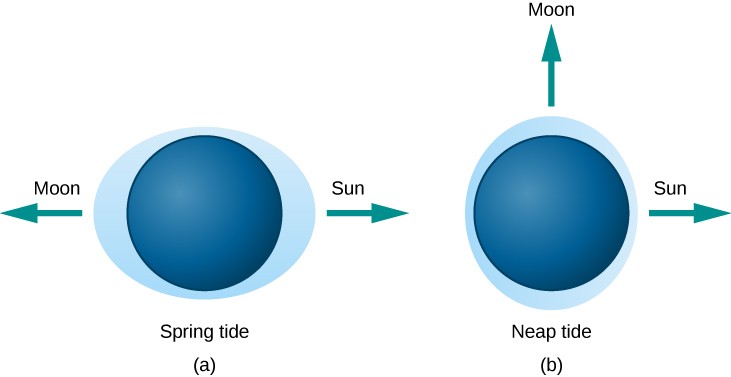
Arrangement of Moon and Sun. Click to enlarge
There are two high tides each day because of the pull of the moon and the earth’s rotation; there are monthly higher ‘spring tides’ during full or new moons when the Earth, sun, and moon are in alignment; and then there are perigean high tides. In a bit more detail:
Daily – the effect of the moon and the Earth’s rotation
On the Christchurch coast tides are semidiurnal, which means our coast receives two high tides each day. High tides occur when our coastal area faces the moon, and the moon’s gravitational force on the water causes a high tide. As the Earth rotates, the moon’s influence decreases, then increases again about 12 ½ hours later.
Monthly – the effect of a Full or New Moon
During full or new moons — which occur when the Earth, sun, and moon are nearly in alignment — average tidal ranges are slightly larger. This occurs twice each lunar month (about 29.5 days on average). There is a new moon when the moon is between the Earth and the sun, and a full moon when the Earth is between the moon and the sun. In both cases, the gravitational pull of the sun is ‘added’ to the gravitational pull of the moon on Earth, meaning that high tides are higher and low tides are lower than average – these are called ‘spring tides’. When the sun and moon are at right angles to each other tides are lower than usual so we have ‘neap tides’.
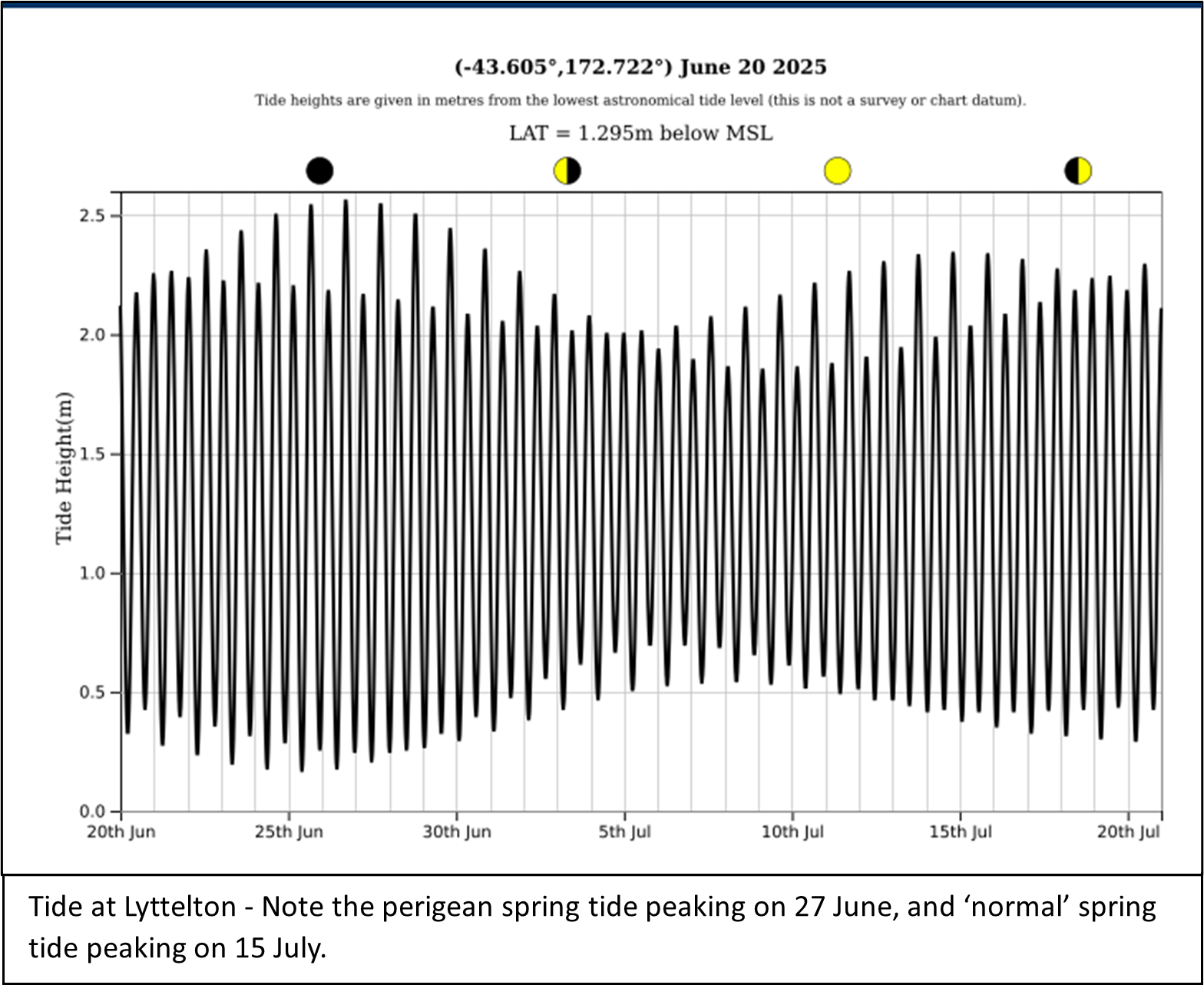
Lyttleton tides. Click to enlarge
Perigean Tides – the effect of the elliptical orbits of the moon and the Earth.
Another influence is the shape of the orbits of the moon and earth. The moon follows an elliptical (oval) path around the Earth in its monthly orbit, and the Earth follows an elliptical path in its yearly orbit around the sun. This means that, at times, the moon and sun are closer to Earth. Once about every 28 days, the moon reaches a ‘perigee’, its closest point of approach to the Earth. This is the point at which the gravitational pull of the moon is strongest.
Typically between 6-8 times each year, the new or full moon coincides closely in time with the perigee of the moon — the point when the moon is closest to the Earth. These occurrences are called ‘perigean spring tides’ and are even higher than a normal spring tide, sometimes called a ‘king tide’. There is a risk of coastal flooding at these times.
NIWA publishes when these perigean spring tides will occur – which they call red alert days.
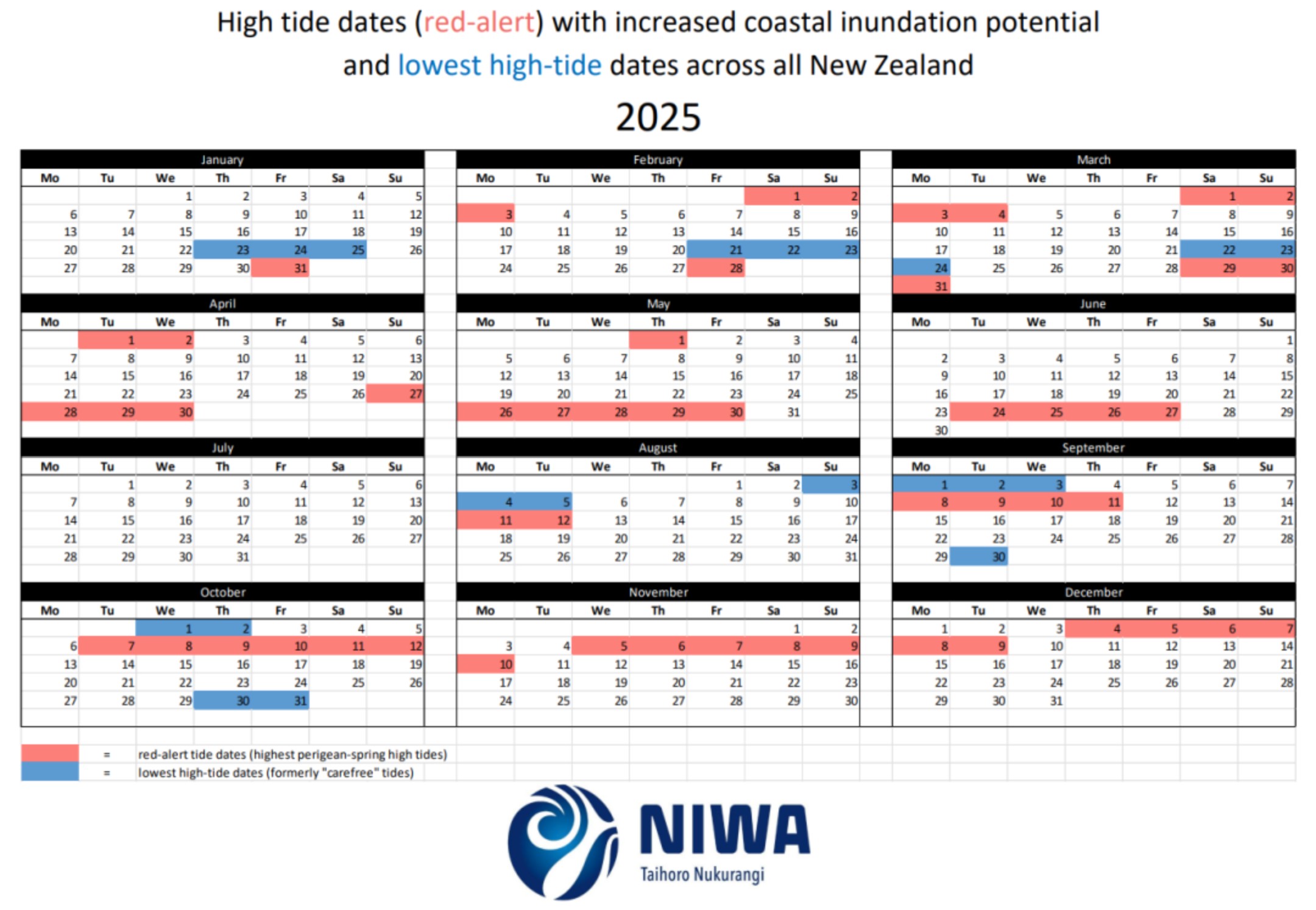
Perigean spring tide calendar. Click to enlarge
For the rest of 2025 king tides will be in the second week of August, September, and October, and the first week of November and December.